Textiles & Everyday Use
Choosing a Bath Robe: Fabric, Fit, and Everyday Use
A robe is a small domestic instrument: part towel, part layer, part permission to move slowly from one room to another. Its comfort depends on more than softness. Fabric, weight, cut, drying time, and care all shape whether it becomes a daily companion or an agreeable object that spends most of its life on a hook.
Published November 9, 2026
There is a particular moment after a bath or shower when the room is warm, the mirror is clouded, and the day has not quite resumed its claims. A robe steps into that interval. It may be thick enough to absorb the water still gathered at the wrists, or light enough to serve as a layer while coffee brews. It may be a practical wrap, a little refuge, or simply the garment closest to hand. The right choice depends on which of these jobs you actually expect it to do.
Shopping for bath robes can seem straightforward until the differences start to matter. “Soft” is a persuasive word, but it doesn’t say how a fabric behaves when damp, how long it takes to dry, or whether its sleeves drag through the sink. Nor does a robe’s size label tell you whether its hem will land above the ankle or threaten to collect dust. A useful decision begins not with a mood board but with the routines the garment must survive.
Begin with the robe’s real assignment
Some robes are asked to do the work of a towel. Others are worn over sleepwear on a cool morning, carried to a pool, or thrown on while answering the door. These are related uses, but not identical ones. A robe intended for post-bath comfort needs to handle moisture and provide coverage. A lightweight home layer can place greater emphasis on airiness and ease of movement. Travel introduces another consideration: bulk in a bag, along with the practical question of whether the fabric will dry between uses.
Before comparing labels, picture an ordinary week. Will the robe be put on while skin is still wet, or only after toweling off? Is the bathroom heated? Will it be worn briefly, or for a long stretch of reading, breakfast, and household errands? How often can it be laundered, and where will it dry? Such questions sound modest, but they prevent a common mismatch: choosing a dense, enveloping robe for a warm home, or a thin, elegant layer when what is wanted is absorbent warmth.
It can help to separate three functions. A robe may absorb, insulate, or cover; many do more than one, but rarely with equal efficiency. Terry cloth is designed around loops that take up moisture. A smooth woven fabric may be comfortable against the skin while absorbing less. A lofty textile can feel warm without being particularly quick to dry. The best robe is not necessarily the one with the most impressive specification. It is the one whose strengths line up with the wearer’s habits.
Fabric and the character of a robe
Fabric names provide a starting point, not a complete forecast. Fiber content matters, but so do yarn, weave, pile, density, and finishing. Two robes described with the same broad material label can feel and perform differently. When available, look for specific details about construction and care rather than relying on a single adjective such as “plush.”
Cotton and terry cloth
Cotton terry is familiar for good reason. Its loops create a substantial surface that can absorb water and feel reassuring after a shower. The same construction may also make the robe heavier, slower to dry, and bulkier to store. A robe that feels like a welcome towel in a cool bathroom may feel cumbersome in a humid climate or during a busy morning when it needs to dry before the next use.
Weight is often described in grams per square metre, though numbers are not always presented consistently. In broad terms, a denser fabric tends to feel more substantial, but weight alone cannot establish absorbency or comfort. Loop length, fabric construction, and finishing also play a part. If you can examine a robe in person, notice whether the loops feel secure and even, whether seams lie flat, and whether the garment’s heft seems pleasant when worn rather than merely impressive on a hanger.
Waffle and other textured weaves
Waffle robes use a raised, grid-like texture rather than the deep loops of traditional terry. They are often chosen for a lighter, less bulky feel and may be easier to pack or hang in a small bathroom. The texture creates a different sensation against the skin, and the open construction can make a garment feel less enveloping. These robes may suit someone who wants a breathable layer, though absorbency and drying time vary with the particular fabric and its weight.
Texture also changes how a robe moves. A thin waffle fabric can fold close to the body, while a heavier one may have more structure. If the robe is intended for damp skin, check the maker’s description rather than assuming that a raised surface will perform like a towel. A textured weave can be an appealing compromise, but “light” and “absorbent” are not interchangeable terms.
Flannel, fleece, and other warm layers
Brushed cotton, fleece, and similar soft fabrics can make appealing robes for lounging, especially in cool rooms. Their role is often insulation and comfort rather than rapid absorption. A robe worn over dry clothes can be excellent at keeping warmth in; one put on directly after bathing may not have the towel-like behavior its thickness suggests. It is worth asking whether the fabric is meant to meet wet skin or simply add a soft layer.
Synthetic fleece can feel light for its warmth and may be straightforward to care for, depending on the garment’s instructions. Brushed cotton offers a different hand and drape. Neither category is uniform: fiber blends, pile height, and finishing influence feel and performance. If warmth is the priority, consider the room temperature and the time of day. A very insulating robe can be a delight in winter and an unwanted burden when the house is already warm.
Silk and lightweight dressing gowns
Silk dressing gowns belong to a different part of the robe family. Their appeal lies in a smooth hand, fluid drape, and light coverage rather than towel-like absorption. They can be useful over sleepwear or as a refined layer at home, but a person stepping straight from a shower will generally need to dry off first. Care requirements also deserve attention: the robe’s appearance may depend on gentle laundering and careful drying, not an indiscriminate trip through a hot wash.
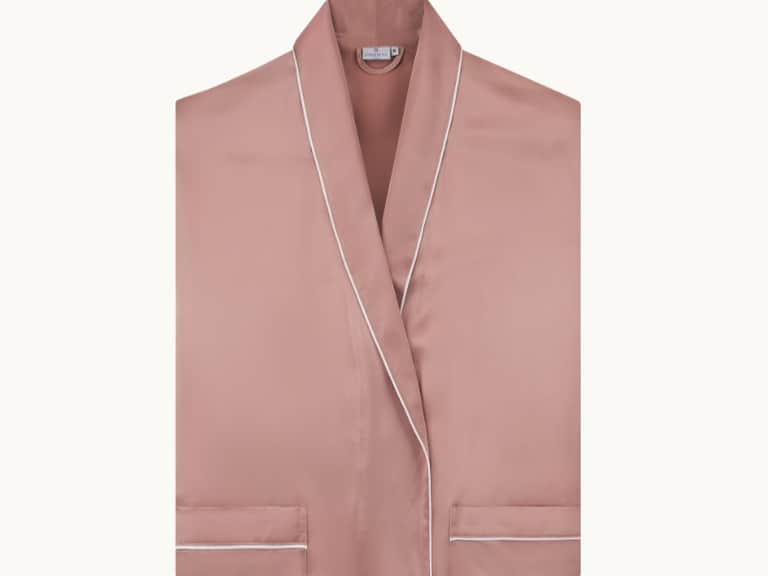
For example, the Woman’s Silk Dressing Gown in Woodrose is described as 100 percent mulberry silk, with ivory piping, two pockets, and a belt supported by internal ties. Its stated weight is 19 momme, and its care instructions specify a delicate machine cycle at no more than 30°C with mild liquid silk detergent, followed by air drying and a cool iron. It is a dressing gown for a light, smooth layer—not a substitute for an absorbent bath towel.
Thickness, warmth, and drying time
A thick robe can offer the enveloping warmth many people want after bathing, but thickness has a second life: it affects what happens after the robe comes off. Dense fabrics may retain moisture for longer and take more space on a hook or drying rack. If the garment stays damp between wears, it may feel less inviting and become harder to manage. A robe that dries reliably in the available space can be more useful than one that feels exceptionally plush for the first five minutes.
Think of warmth and drying as a balance rather than a contest. In a chilly room, substantial fabric may be worth the extra drying time. In a small bathroom with limited ventilation, a lighter robe may be more practical. The number of people sharing the garment, the frequency of use, and the interval between laundry days all matter. For a frequently used robe, a hanging place with good airflow is not an afterthought; it is part of the garment’s working conditions.
Care labels offer clues to the fabric’s limits. Washing temperature, cycle, drying method, and restrictions on ironing or bleach can influence how easy the robe is to maintain. A garment that requires more attention is not automatically a poor choice, but the instructions should match the care you are willing to give it. If a robe is meant for everyday use, it is sensible to consider how its fabric will behave after repeated laundering, not just how it feels on the first day.
Fit is a practical matter
Robe sizing is often generous, and a belt can make a loose cut seem forgiving. Even so, a robe that is too large may slide at the shoulders, trail at the hem, or wrap in a way that feels insecure. A robe that is too small may pull across the back, leave little overlap at the front, or make it awkward to sit down. The goal is enough ease for comfortable movement without excess fabric that interferes with ordinary tasks.
Check the garment’s measurements when they are available, especially chest or body width and length. Size charts can vary by maker, and labels such as small or large are not universal. If you plan to wear the robe over pajamas or heavier sleepwear, allow for those layers. If it will be used mostly over bare skin, a closer fit may feel less cumbersome, provided the robe still closes securely and does not restrict reaching or bending.
Sleeves, hem, and coverage
Sleeve length can determine whether a robe feels convenient or constantly in the way. Sleeves that cover the hands may be cozy, but they can become inconvenient at a sink or while preparing a drink. A cuff that sits near the wrist is easier to manage for many everyday tasks. Consider how the sleeve falls when your arms are relaxed and when you reach forward; the two positions can reveal different problems.
Hem length is similarly personal. A longer robe offers more coverage and can feel warm, but a hem that brushes the floor may catch underfoot or pick up dust. A shorter cut can be easier to move in, though it may not provide the same coverage when sitting or bending. Rather than choosing by appearance alone, think about where the robe will be worn and what movements are routine. The best hem is the one that stays out of the way without leaving the wearer wishing for more fabric.
The belt, pockets, and small decisions
A robe belt should be long enough to tie comfortably and should stay in place as the wearer moves. Internal ties, when provided, can help keep the garment aligned; belt loops help prevent the belt from disappearing into a laundry basket or drawer. Check that the belt is not so narrow or slippery that it loosens easily, and that the robe still overlaps adequately when tied.
Pockets seem like a minor detail until they are missing. They can hold a phone, a tissue, or a small object carried around the house, but their placement affects how useful they are. Pockets set too low may swing against the thighs; ones placed too high may be awkward to reach. Their depth and stitching matter as well. A large pocket is not automatically better if it pulls on a light garment or distorts its drape.
Care that preserves comfort
Always begin with the garment’s own care instructions. General advice can be useful, but fiber blends and finishing methods vary, and a robe’s label is the clearest guide to its intended treatment. Washing too hot, using a cycle that is too rough, or applying unsuitable products can change texture, affect fit, or shorten the useful life of the fabric.
For absorbent cotton robes, following the stated washing and drying directions helps maintain the fabric’s feel. Avoid assuming that fabric softener is always helpful; it can affect absorbency in some towel-like textiles. For delicate materials such as silk, the instructions may call for a mild detergent, low-temperature washing, and air drying. Do not substitute the care routine of one robe for another simply because both are worn after bathing.
Between washes, let the robe dry fully in an airy place. A thick garment folded over a narrow hook can remain damp in its layers; spreading it open on a suitable hanger or rail can encourage more even drying. If the robe is used daily, inspect the belt loops, seams, pocket openings, and cuffs from time to time. These are ordinary points of strain, and a small repair can be easier before a seam begins to unravel.
A short checklist before choosing
When comparing options, it helps to bring the decision back to a handful of practical questions. A robe does not need to excel at everything. It does need to suit the way it will actually be used.
- Purpose: Is it meant to absorb water, provide warmth, cover sleepwear, or do a combination of these?
- Fabric: Does the weave and fiber feel appropriate for damp skin or for wearing over dry clothes?
- Weight: Will its thickness feel comfortable in the room where it will be worn?
- Drying: Is there enough space and airflow for the robe to dry between uses?
- Fit: Do the body, sleeves, and hem allow comfortable movement and suitable coverage?
- Details: Are the belt, internal ties, loops, and pockets positioned in useful places?
- Care: Do the washing and drying instructions fit your household routine?
The robe that earns its place
A good bath robe does not announce itself every time it is worn. It closes without fuss, falls comfortably at the shoulders, and does not require a negotiation with the sleeves. It dries in the time and space available. Its fabric makes sense for the room and the moment: terry for someone who wants an absorbent wrap, a lighter weave for someone who values ease, or a smooth dressing gown for a dry, soft layer at home.
That is why the most useful comparison is not between the grandest descriptions but between the needs of the wearer and the behavior of the cloth. Absorbency, warmth, and weight have consequences beyond the fitting room. So do sleeve length, pocket placement, and laundering instructions. Together, these modest details determine whether a robe becomes a dependable part of the day or merely an attractive thought.
Choose with the actual bathroom, climate, laundry routine, and morning in mind. A robe is not a complicated garment, but it lives close to the body and close to habit. When fabric, fit, and care are in agreement, it makes the transition from bath to day feel less like a task and more like a small, well-arranged pause.